

RE;CODE – putting circular design centre stage

About RE;CODE
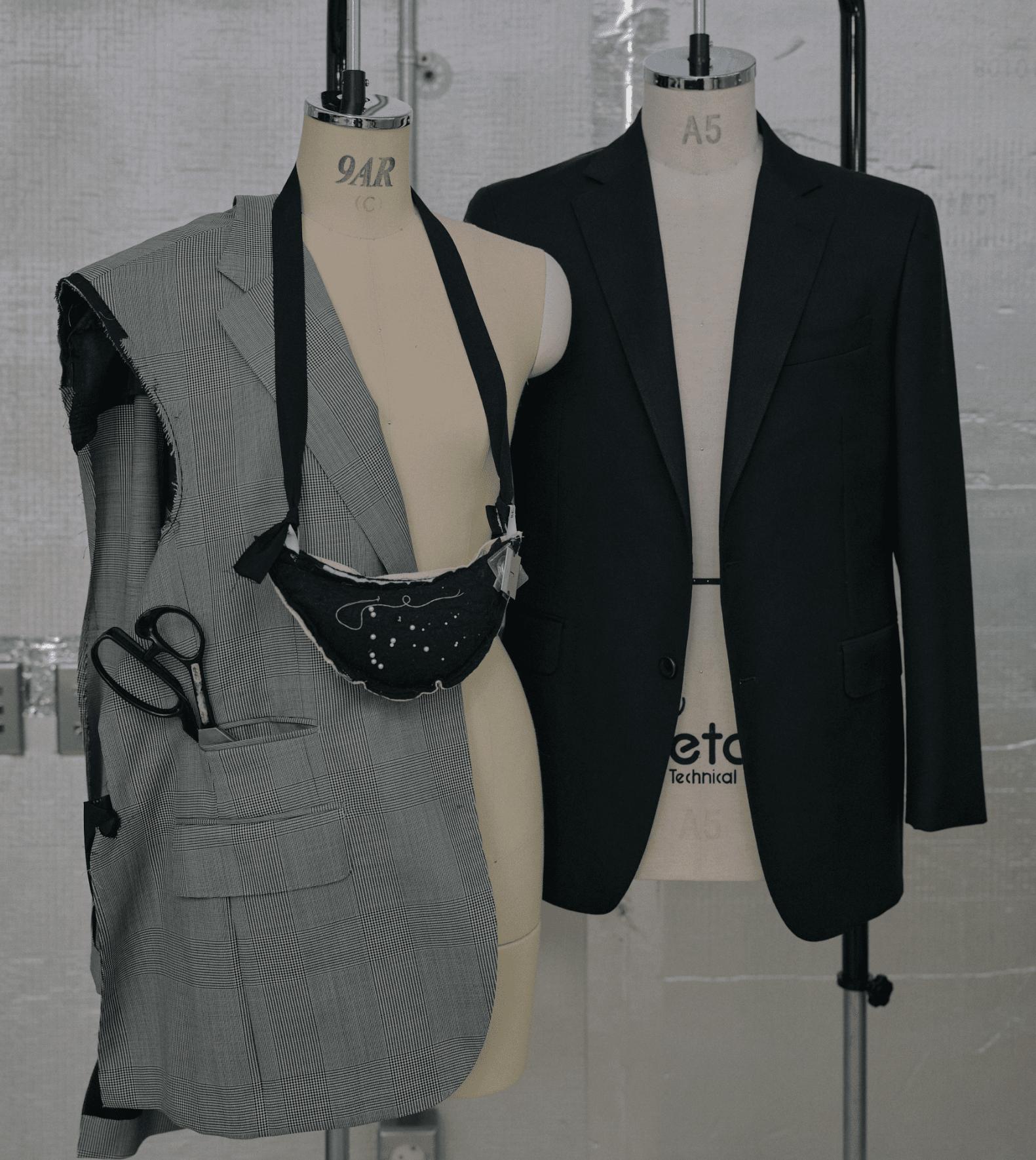
RE;CODE is a manufacturer, brand and service provider that creates garments, bags and accessories from deadstock and re-purposed industrial materials, such as airbags and car seat covers.
Established by Kolon FnC in 2012, RE;CODE works as part of a series of circularity initiatives designed to eliminate waste and keep. garments in use for longer (1).
As part of the FnC division of Kolon Industries (Kolon FnC) in Korea, it offers inventory solutions across the division and to other companies, through partnerships (2).
Summary
Eliminating waste and keeping materials in use at their highest value for as long as possible are core principles of a circular economy (3). Despite growing awareness of the circular economy’s importance in supporting nature-positive and net-zero outcomes, many brands face challenges when it comes to embedding circularity in their business – from the product design stage and business model, to engaging customers.
This case study explores how RE;CODE has taken a creative approach to exciting customers about circularity, from working with local artisans to some of the world’s K Popstars BTS and Michelin-starred chefs.
The Challenge
Materials efficiency has always been a part of best practice in the fashion industry, with brands looking to maximise value and minimise loss through waste, at pre and post-consumer stages. Often this leads to materials being downcycled, for example used or unsold garments cascading down into secondary markets and eventually to industrial use such as rags or mattress stuffing (4), failing to capture the full benefits of circularity, either environmentally or economically.
Circular Business Models for Fashion
The Ellen MacArthur Foundation defines the four main circular business models as rental, repair, resale and remaking.
Rental: This includes one-off peer-to-peer rentals by private owners, as well as large-scale rental and subscription models by multi-brand platforms or individual brands.
Repair: This is the operation by which a faulty or broken product or component is returned back to a usable state. For The Fashion ReModel, this includes alteration and repair services on products currently owned by consumers, not product returns or damaged stock.
Resale: This includes peer-to-peer sale of second-hand items, third-party marketplaces, and own-brand re-commerce.
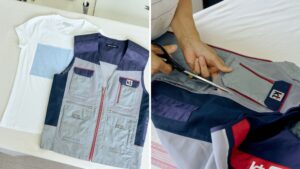
Remake: This is the operation by which a new product is created from existing products or components. This operation can include disassembling, re-dyeing, and repurposing.
RE;CODE’s Solution
RE;CODE uses several circular economy approaches to overcome these issues:
- Deadstock and textile waste from across Kolon FnC’s warehouses, serving 30 brands, are used to produce new designs and new collections through a team of designers and artisans. Also Kolon’s diverse portfolio means this includes repurposing military and industrial garments which have been deconstructed and washed (5).
- Small-scale production prevents overproduction
- Artisan craftsmanship is combined with local production, with more than 80% products produced in Korea (6).
- RE;CODE is part of a wider set of circular economy initiatives operated by Kolon.
While RE;CODE focuses on upcycling, Kolon uses related initiatives to tap into the wider opportunities of a circular economy for fashion:
Resale: OLO Relay Market
OLO Relay Market is Kolon Industries FnC’s exclusive branded product resale market, operated in partnership with Relay (Madeleine Memory Co., Ltd) (7).
Remake and Repair: BOX ATELIER
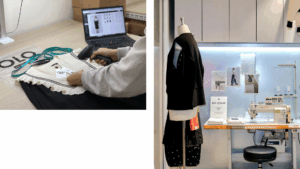
BOX ATELIER is RE;CODE’s remake and repair service that allows customers to transform or extend the life of old clothes (8). (Currently unavailable but due to resume in store following maintenance).
Customisation: M.O.L
The M.O.L (Memory of Love) a personal redesign service that lets customers transform old products and personal items. Once a garment is completed, a note detailing the upcycling process is included for the customer (9).
RE;TABLE
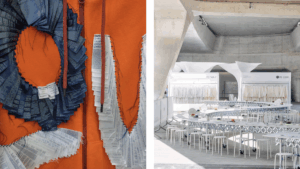
Promotes upcycling skills to the public and provides employment opportunities for single mothers to become upcycling workshop instructors in Korea (10).
Education: Circular Library
Circular Library, a physical store, opened in LA in December 2023, selling upcycled products and products made using lower impact materials and production. Beyond this, it promotes circular practices such as repair through public courses teaching skills such as sewing, circular design and upcycling (11).
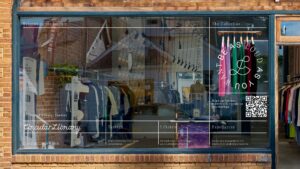
RE;CODE also uses creative partnerships to introduce circularity to new audiences in engaging ways. For example, a partnership with car manufacturer Kia, saw them develop an upcycling vending machine that sold goods made from dismantling and recombining by-products of automotive interior materials such as airbags and car seats. They have also partnered with the likes of Nike, as well as the K-POP band BTS, producing upcycled suits to help reinforce their message during a speech at the United Nations General Assembly.
In 2025, it collaborated with Object IV Life, the brand launched by Daniel Arsham and partnered with Michelin-starred restaurants in Korea to design uniforms. Another key initiative saw it partner with Korea University Hospital and Kolon’s Future Technology Institute: to chemically recycle discarded surgical gowns and hospital uniforms into regenerated polyester yarns, which RE;CODE used to produce new uniforms.
Beyond these collaborations, the brand has organised exhibitions to introduce its activities directly to the public, making upcycling more tangible and accessible, encouraging consumers to adopt sustainable behaviors.
Impact
Since 2014, RE;CODE has been tracking its impact across four main categories: the number of recovered inventory garments, the number of repair/reform requests, the number of collaborations/partnerships, and the number of participants in workshops (called RE;TABLE) aimed at promoting a culture of sustainability.
- Number of recovered inventory garments 34,223
- Number of repair/reform requests 2,557
- Number of collaborations/partnerships 169
- Number of RE:TABLE workshop participants 24,037
- Eliminating waste: They saved 34,223 pieces of textiles from going straight to end-of-life until the third quarter of 2025.
Key Learnings
- Unlike most conventional brands, which start from a market trend perspective, RE;CODE first identifies what inventory is available and how it can be revived. Only after that does it integrate design elements that align with market trends.
- In terms of pattern-making, the process involves not only developing new product patterns but also carefully reviewing the patterns of the existing inventory that serves as raw material.
- In production, an additional stage is included: dismantling the original materials with care so as not to damage them, and then reassembling them into new forms.
- When it comes to sales and marketing, RE;CODE dedicates time to not only present the final product, but to explain which existing products were repurposed and how they were reimagined.
- To ensure products are successfully repurposed RE;CODE’s key teams consist of a pattern maker, seamstress and designer working closely together.
- The upcycling process requires greater effort and precision compared to producing new products. This makes collaboration with master artisans essential to enhancing the quality of garments. This is because the work involves small-batch, multi-variety production rather than mass production. As a result, RE;CODE relies on local producers, helping to keep carbon emissions lower and enhancing production efficiency.
Looking Ahead
RE;CODE is continuing to work on projects that create a strong impact and can be shared widely with the public. In Korea and across Asia, it is preparing collaborations with well-known brands and is continuing to work with global artists on creative initiatives.
Rising awareness of its work has also led to ongoing discussions with global luxury brands, looking to adopt its upcycling solutions and they are now carrying out projects that involve receiving unsold stock from luxury brands. This stock would have previously been destined for incineration, but will now be transformed through upcycling.
It also plans to expand partnerships with domestic artisans and local producers to improve both quality and efficiency.
Sources:
-
- UKFT Circular Manufacturing Report
- About – Recode Global
- Circular Economy Principles, EMF
- Fashion has a huge waste problem. Here’s how it can change | World Economic Forum
- Circular Manufacturing Report, UKFT (provided by Kolon)
- RE;CODE website
- https://orm.the-relay.kr/
- https://en.kolonfnc.com/press/902
- https://www.kolonfnc.com/press/1245
- https://recode-global.com/pages/re-table
- https://recode-global.com/pages/mol
Images
All images were provided with authorisation by Kolon Industries FnC and approved for use in this case study. External sources: Official Instagram accounts of RE;CODE, RE;TABLE, and M.O.L; Remake and Repair: Box Atelier ; UKFT Circular Manufacturing Report.