

Invasive Alien Species - A Risk Fashion Cannot Ignore


Invasive Alien Species (IAS) can drive down fibre yields, jeopordise supply continuity, and raise input costs for fashion brands. Yet they often fail to receive the same level of attention as other risks threatening the industry.
As part of a recent knowledge sharing session, The Fashion Pact brought together experts from The Biodiversity Consultancy, to examine not only these risks, but the opportunities to tackle IAS and bring benefits across the industry.
IAS are a key driver of biodiversity loss, according to IPBES (the Intergovernmental Science-Policy Platform on Biodiversity and Ecosystem Services), which listed IAS as being partly or fully responsible for around 60% of recorded extinctions globally (1).
Beyond their impact on the environment, IAS are increasingly recognised as a material risk to industry. Scientists estimate they cost the African agricultural sector USD 65 billion every year, equivalent to about 2.5% of the combined GDP of all African countries (2)
“While their impacts can be slow to materialise, they can be catastrophic when they do,” said Lizzie Biggs, of The Biodiversity Consultancy.
To be considered an IAS, a species must meet two conditions. It must have moved from its native habitat to a non-native habitat where it has not historically been found, and it must be able to establish in the new environment causing harm to humans and nature.
Once introduced to a region, factors such as low biodiversity due to monoculture farming, and fertilizer pollution, increase the chances of an IAS becoming established.
Fashion’s globalised supply chains can increase the movement of different species across continents and landscapes, including unintentionally through raw materials, packaging, and transportation.
“The key takeaway is that the spread of invasive alien species isn’t caused by a single activity in the value chain. That means there are multiple intervention points within the fashion value chain where companies can reduce their risk of contributing to the spread of invasive species,” said Lizzie.
Examples include species used for fur production, such as the American mink, which have established invasive populations in the wild after escaping captivity. More recently, some alternative or sustainable fibre sources have created new risks, such as bamboo escaping plantations and spreading into local native forests. Eucalyptus, which is also used as a feedstock, but sometimes grown in large monoculture plantations, can have low resistance to the spread and establishment of invasive species.
Double Materiality
Fashion’s relationship with IAS runs two-ways. Not only does the industry contribute to the spread, it faces significant risks from their introduction and establishment.
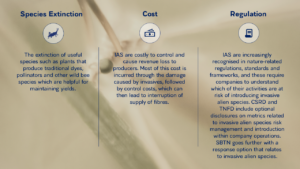
“Weeds and diseases cause direct yield loss, but there are also indirect effects. For example, they can cause species extinctions which lead to reducing populations of native pollinators that would have helpfully eaten pests and acted as a biological pest control. Beyond these direct impacts is an opportunity cost, with time and resources spent eradicating and controlling invasive species that could be invested in education, paid work and community livelihoods,” said Lizzie.
Example: The Cotton Mealybug
The cotton mealybug, native to North America, was first recorded in Pakistan in 2007, most likely introduced through contaminated cotton materials or trade flows. Its small size, high reproductive rate, and ability to feed on multiple host plants enabled rapid establishment and spread across major cotton-growing regions thanks to environmental pathways and commercial movement of infested inputs and fibre.
It is now present in more than 20 cotton-producing countries (3) , with serious implications for fashion supply chains including:
- 30–60% yield losses in affected regions, reducing fibre availability (4)
- Fibre quality degradation, affecting product specifications
- Increased pesticide use, driving higher input costs and Scope 3 impacts
- Crop destruction by farmers to prevent spread
- Worker health risks linked to chemical control
The Solutions
Brands, suppliers and producers can intervene at different stages to tackle the risks of IAS:
Preventing and reporting
- Avoid the deliberate importation of IAS for display or sale and support suppliers to strictly adhere to international biosecurity conventions.
- Request compliance to biosecurity measures and audit reports.
Detecting and eradicating
- Incentivise and support suppliers to follow certification guidelines around chemical controls.
- Support the development of specific IAS referencing in certification and standards.
Containing
- Support procedures to implement integrated pest management using a combination of non-toxic interventions to reduce pest numbers.
Controlling and restoring
- Invest in habitat restoration, adjacent to farms to encourage increased populations of native pest predators.
- Increase crop diversity to boost resilience.
“Invasive alien species are no longer a niche ecological issue for conservationists, but they’re a recognised component of nature related risk, strategy and disclosure. Early understanding of your relationship with invasive alien species can help you to stay ahead of emerging guidance and reduce future compliance burden and strengthen credibility in nature reporting.” | Lizzie Biggs
Fashion Pact Activity
As part of our evolved impact strategy, The Fashion Pact worked with our ecosystem of members, partners and experts to define a Collective Ambition for nature: “Avoid and reduce the drivers of nature loss, create solutions that restore and regenerate nature, and enable transformative business models, actions and commitments.”
Thank you to The Biodiversity Consultancy for their collaboration and for contributing these valuable insights. To learn more, visit: www.thebiodiversityconsultancy.com.
Sources
(1) Media Release: IPBES Invasive Alien Species Assessment, IPBES, Sept 2023
(2)Towards estimating the economic cost of invasive alien species to African crop and livestock production, CABI Agriculture and Bioscience, May 2021
(3)The invasive mealybug Phenacoccus solenopsis Tinsley, a threat to tropical and subtropical agricultural and horticultural production systems – A review, Babasaheb B. Fand, Sachin S. Suroshe, 2015.
(4) Ibid