

Circular
Economy
The fashion industry faces an urgent materials challenge. Despite growing regulatory pressure and brand commitments, the transition to textile-to-textile (T2T) recycled and next-generation fibres remains stalled. Significant barriers continue to hinder progress at scale, including fragmented demand, insufficient financing, and a lack of well-developed recycling infrastructure and supportive policy frameworks. Supply and demand remain disconnected—especially for post-consumer materials—creating a “chicken-and-egg” stalemate that requires collaborative efforts across the value chain.


Circular Fibre Collective
About the Initiative
The Circular Fibre Collective (CFC) is a cross-industry initiative co-launched by The Fashion Pact and Fashion for Good, with strategic support by the Ellen MacArthur Foundation, to accelerate the adoption and scaling of textile-to-textile (T2T) recycled and next-generation fibres. By facilitating voluntary forms of aggregated demand across brands and suppliers, creating enabling conditions for investment, advancing supportive policy, and providing practical adoption tools, the initiative will send a clear market signal to innovators, suppliers, and financiers, giving them the confidence to scale and invest in circular fibre solutions.
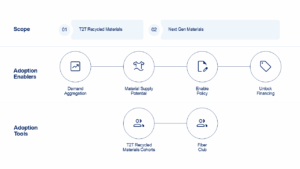
The Collective is structured around two pillars. The first focuses on adoption enablers, including facilitating voluntary forms of aggregated demand, supporting the development of individual non-binding commitments, as well as policy exploration, and financing unlocks. The second provides practical adoption tools such as Fashion for Good’s Fiber Club, a Toolkit on next-generation materials, and T2T Recycled Materials Cohorts to help brands overcome commercial barriers to adoption.
The initiative was shaped by a consultation with 25 leading fashion brands and builds on the research outlined in Fashion for Good and BCG’s February 2025 report, Scaling Next-Gen Materials in Fashion, which identified 13 million tonnes of next-gen and T2T material needed to shift the market by 2030.
The Collective focuses mainly on textile-to-textile (T2T) post-consumer recycled materials (mechanical recycling) and next-generation fibres (including chemical recycling). As a first step, the Collective will start by focusing on priority materials identified, to ensure measurable progress in areas where the market failure is most acute.


Structure Overview
About the Workstreams
The CFC will cover several different workstreams:
Demand aggregation potential: Creating market confidence by establishing an understanding of the collective demand volume potential for T2T and next-generation materials through 2030, across Circular Fibre Collective brands, retailers and suppliers. In parallel, the Collective will explore the potential commitments with members – ranging from non-binding demand signals (such as public targets or Letters of Interest) to more structured arrangements that strengthen demand visibility, including, where relevant, offtake agreements.
The objective is to identify practical approaches that signal credible demand to the market and help unlock investment, while remaining accessible to participating companies.
Launched in Q1 2026, this work is led by The Fashion Pact, with support from Fashion for Good.
This is only the starting point. Building on existing data and industry assessments, the Circular Fibre Collective is analysing the material supply landscape – collating information on collection, sorting, pre-processing, and recycling capabilities – to better understand the potential scale of collective supply.
The initiative is also scoping work to understand how financing mechanisms can accelerate the scaling of textile-to-textile recycled and next-gen materials. Additional work to explore policy barriers and opportunities to create a more favourable environment for these materials is also being planned, with the Ellen MacArthur Foundation well-placed to play a leading role in this work.
The following tools will support T2T & Next-Gen adoption in practice amongst brands and suppliers:
- Fiber Clubs from Fashion for Good, bringing together selected innovators and brands to enable faster adoption of next-gen materials – participation open to brands, with new cohorts being set-up based on priority material needs identified
- Toolkit from Fashion for Good, an industry-designed framework and suite of tools to help bridge the general cost gap between next-gen and conventional materials
- Calls to action and T2T Cohort bringing together selected recyclers and brands on priority recycled materials (post-consumer, mechanical recycling focus) along with key suppliers by specific regions (starting Q2 2026).
Further workstreams are currently in development and will be shared once more advanced.
Industry players, brands and suppliers interested in joining the Circular Fibre Collective are invited to contact The Fashion Pact and Fashion for Good here to learn more about engagement opportunities.
Benefits for Brands
By joining now, brands will have the opportunity to:
Anticipate upcoming regulations such as ESPR (Ecodesign) or EPR (Extended Product Responsibility) and through eco-modulation
Signal the aggregated demand to the market, opening doors to further investors and/or collaborators and unlock the scale-up of textile-to-textile recycling and next-generation materials
-
Address common challenges through collaboration
Unlock financing for T2T and Next-gen scaling, including for infrastructure