

'No Clean Fish in a Dirty Pond’ – H&M Group, Water Stewardship & Supplier Engagement


Summary
Supply chains globally face growing risks related to their use of water. This is particularly true in fashion, where production is often located in regions of intensely clustered facilities. Many of these locations are already experiencing challenges around water quality, flooding or droughts. These are expected to worsen in the coming decades due to population growth, failing water infrastructure, and weak or insufficiently enforced regulation.
H&M Group, in partnership with the World Wildlife Fund (WWF), is using contextual targeting, strategic partnerships, and local engagement around water basins, to increase water efficiency and improve water in some of the world’s most water-stressed regions. It submits water quantity and quality targets for key basins with support from WWF as part of a Science Based Targets Network (SBTN) Science Based Targets for nature pilot. It also uses SBTN guidelines to align efforts in high-risk basins through area-specific models and a shared approach with stakeholders. Its pilot target on water quality has been approved by SBTN.
The vision for this Water Stewardship strategy is to “have a positive impact on water by 2030, build resilience to water crises and catalyse innovation that decouples the fashion industry from water.” H&M Group
In addition to the benefits for itself and the environment, H&M Group highlights positive impacts for suppliers, including reduced costs due to efficiency, protection from disruption due to water supplies, license to operate within legal frameworks, and enhanced brand value.
What are contextual targets?
Contextual water targets represent a middle ground between non-contextual and water SBTs. These targets embrace efficiency and management concepts (traditionally non-contextual approaches) but move further by accounting for the needs of local water-related challenges. They do not, however, go so far as to tackle precise levels of performance required by a business to contribute towards the achievement of basin-level science-based outcomes. As such, contextual targets represent a concrete starting point for businesses seeking to take the first step towards water SBTs.
Robust and meaningful contextual targets should be constructed using five component parts:
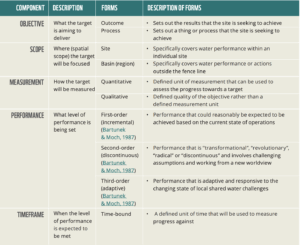
Source: Contextual Water Targets: A Practical Guide for Setting Contextual Corporate and Site-Level Water Targets (2021) WWF/H&M Group
The Challenge
Water-related issues present not only operational risks to brands – with production being vulnerable to too much or too little water, as well as issues around water quality – but also reputational risks when eco-systems are degraded. Regulatory pressure is mounting, including the introduction of CSRD in Europe, which requires companies such as H&M Group to disclose pollution-related impacts, risks, dependencies and opportunities in its supply chain and to reduce water consumption in areas of water risk.
Production facility clustering means many users can rely on the same water basin, with poor practice by any single user affecting all the users. This makes supply chain engagement and stakeholder collaboration critical to water stewardship strategies.
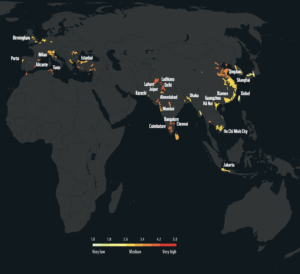
Fig. 1: The physical water risks of Apparel and Textiles Clusters (focus on Europe, Africa and Asia). Avant-Garde: The Water Risks and Opportunities Facing Apparel and Textile Clusters. WWF / Open Supply Hub (2022).
H&M Group’s Approach
H&M Group’s Water Stewardship strategy is part of a holistic approach, developed with WWF, which recognises the interplay between water, biodiversity and climate.
On water, the collaboration focuses on reducing risks in the supply chain, embedding water considerations into decision-making, and ensuring the importance and risks around water are understood across the supply chain.
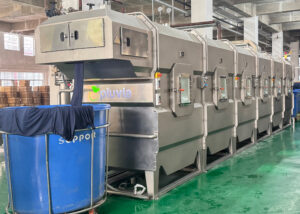
Image: One of the pilots for waterless dyeing technologies started in spring 2025 at H&M Group’s supplier, Chorka Textiles, in Bangladesh.
The strategy establishes effective water governance should ensure water is shared equitably and acknowledges that a lack of governance can result in serious harm to the environment, local communities, and economies, as well as supplier facilities. For example the release of untreated wastewater from factories can undermine local fisheries, impact food security, and create a lack of access to clean water, adequate sanitation and hygiene practices (WASH), as well as impacting production.
To address these complex risks, meet the needs of diverse stakeholders, and solve specific local level issues, H&M Group has moved from top-down corporate targets to contextual targets focused at the facility level.
Working with Quantis they have developed a Water Stewardship Action Tool that helps suppliers to assess their water risks, establish action plans to address them, and then measure impact through a dashboard. In addition, H&M Group, with Quantis, has provided guidance and a simple 5-step process to help suppliers get started.
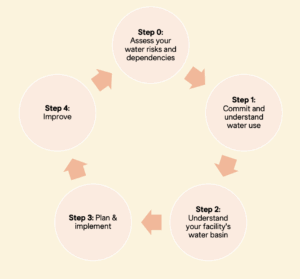
Fig. 2 Suppliers’ Water Stewardship Guidance, H&M Group, Oct 2024
By implementing the 5-step process, facilities develop a water stewardship plan, which outlines water impacts and dependencies, and identifies clear commitment and actions to improve the state of the water basin.
The tools and guidance walk suppliers through the process, from understanding their own impacts on a water basin, to mapping other stakeholders they will need to engage with, developing action and incident response plans and identifying the best solutions. Finally it guides suppliers on the process of continuous improvement.
Impact
H&M Group’s target is is to reduce absolute freshwater consumption in tier 1 and 2 production factories by 30 percent by 2030, against a 2022 baseline. This is complemented by a milestone target to reduce consumption by 10 percent by 2025.
In 2024, H&M Group’s freshwater consumption was reduced by 9.5 percent compared with the baseline. Compared with 2023, freshwater consumption decreased by 0.4 percentage points even as total material weight increased during the year.
The company said this was primarily the outcome of increased recycling of water during the year. Water recycling in our supply chain ramped up to 19.6 percent in 2024, compared with 12.2 percent in 2022.

Key learnings
- The importance of effective partnerships: H&M Group’s longstanding and deep collaboration with WWF across related topics has allowed them to build holistic strategies that address the connected challenges of biodiversity, water, and climate.
“The partnership between WWF and H&M Group is founded on a joint vision for a sustainable future for people and nature. The purpose is to address key environmental impacts in the H&M Group’s value chain, with a special focus on water, biodiversity and climate. Our work also aims to lead and inspire other companies within the fashion industry but also beyond, towards solutions that keep within the boundaries of our planet.” WWF
- Contextual targets, contextual support and contextual solutions: The switch to contextual targets has allowed H&M Group to emphasise the importance of local solutions, working closely with suppliers and communities in regions like Bangladesh, India, and Indonesia to address unique water challenges through initiatives like water efficiency with a focus on process optimisation.
Looking ahead
H&M Group is prioritizing high impact basin-level engagement, where peer brands and other industry actors can work together, ensuring the best utilisation of resources. For example, where water from one industry can be reused by another, such as water from municipal treatment plants being used in textile production.
The group has invested in waterless dyeing technologies at two suppliers, Arvind in India and Chorka Textiles in Bangladesh, with the potential to reduce greenhouse gas emissions and water use by half. Once fully operational (due to be this year), they will assess their performance and potential to scale.
All images provided by H&M for external use in this publication.